
What sprouting changes.
Every commercial millet and sorghum flour we can find in the United States is milled from raw grain. We germinate ours first. This page is about what that does to the material you would be formulating with, rather than what it does in a marketing sentence.
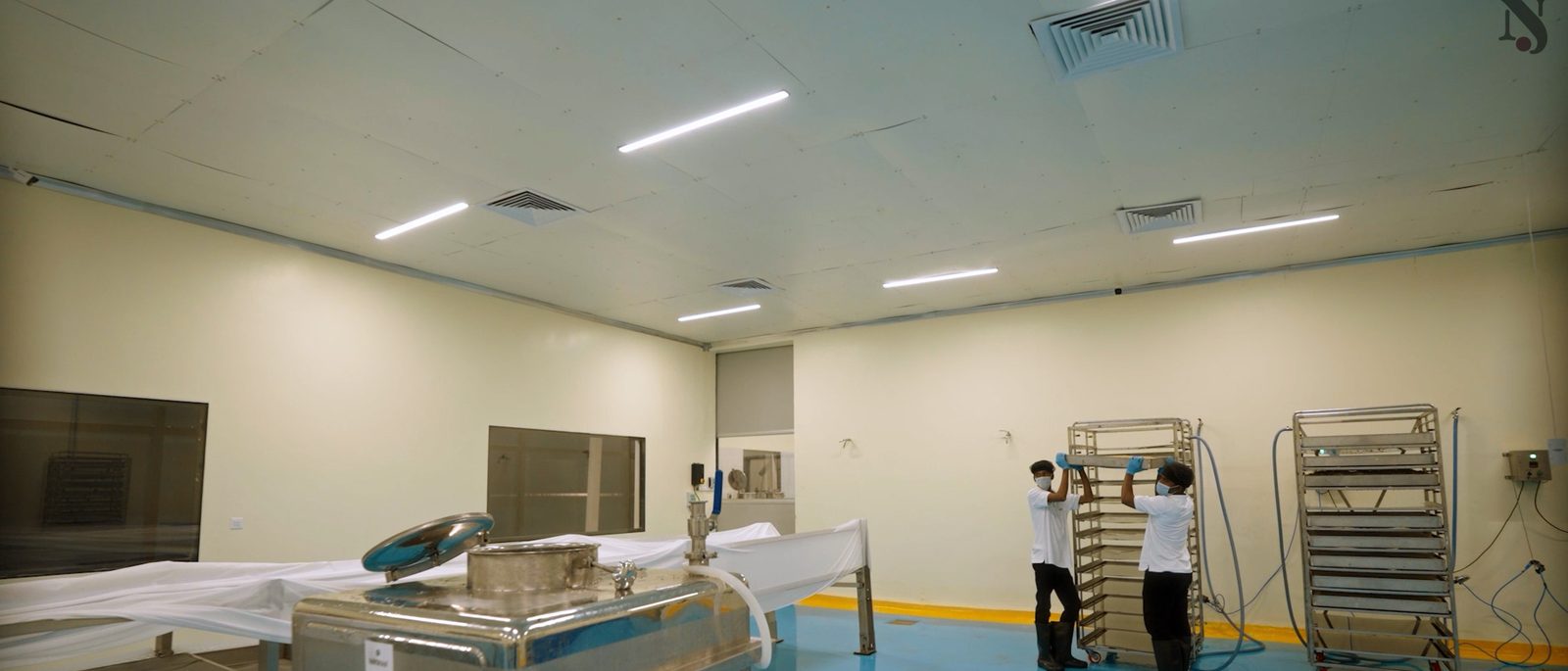
Four controlled stages
Soaking grain is a standard household practice. Doing it identically across commercial volumes requires strict environmental controls.
Clean, grade and wash
Incoming grain is cleaned and stored under natural CO2 rather than chemical fumigation.
Soak
Time and water temperature are strictly controlled to hit a target moisture level. Under-soaking causes uneven sprouting; over-soaking triggers fermentation.
Germinate
Grain is held at 28 to 32 degrees and 50 to 90 per cent relative humidity for 48 to 72 hours. Release is on a minimum post-germination hold of 48 to 60 hours, not on visible sprouts. Phytate degradation continues after sprouting is visible, so stopping early costs you the thing the process is for.
Dry and mill
We arrest germination in a fluidised bed dryer, then mill through an 80 mesh screen. Product temperature stays at 40 to 45 degrees. This is a drying and stabilisation step, not a thermal kill step, and we do not present it as one. Roasting is faster, but the high heat destroys the enzymes and nutritional profile that germination just produced. From cleaning onward the product is not handled by hand.
Three things a formulator will notice
Bitterness falls
Raw pearl and finger millets carry a bitter, chalky aftertaste caused by polyphenols in the bran. This bitterness is usually the ceiling for formulators: you run into a flavour limit long before you run into a functional one. Sorghum is the mildest of the three and is the reason the blend has a neutral base at all.
Water absorption shifts
Sprouting partially breaks down the starch and protein structure. In our trials, sprouted finger millet holds noticeably more water, producing a softer, moister crumb. Because sprouted flour absorbs more water, you cannot usually substitute it one for one against raw commodity flour. You will likely need to adjust hydration levels in your formulation during initial bench trials.
Phytic acid is degraded
Raw millet is highly nutritious, but it is packed with phytic acid, an anti-nutrient that binds to minerals and prevents the body absorbing them. Sprouting activates the grain’s own phytase enzyme, which degrades it. Measured on paired raw and sprouted material across nine production lots, finger millet falls from 1,050–1,200 to 250–274 mg/100g, sorghum from 550–650 to 230–250, and pearl millet from 750–850 to 250–350.
What we are not claiming
Phytate reduction and human mineral absorption are related, but they are not the same legal claim.
We now hold strict nine-lot paired testing data showing our sprouting process reduces phytic acid by up to 77 % and crosses the published molar ratio thresholds for calcium and iron. What we do not have is a human absorption study, and we are not going to imply one.
Similarly, while germination can raise certain bioactive compounds, we have not measured every one of them in our specific product, so we do not invent numbers for them.
If a specific label claim matters to your formulation, tell us. We would rather run the exact laboratory test for you than argue from academic literature.
What this lets you put on a label.
Your R&D team decides whether the ingredient works. Your marketing team decides whether it is worth paying more for than commodity flour. This section is for the second conversation.
To save your regulatory team time, here is exactly what our laboratory data supports, and what it does not.
| “Made with sprouted millet” | Supported · process claim, production records |
|---|---|
| “Gluten-free” | Supported · not detected at LOQ 2 ppm, third-party |
| “Good source of calcium” | Supported · lab data, depends on your FDA serving size |
| “Reduced phytic acid” | Supported · paired raw vs sprouted across lots |
| “Improved mineral bioaccessibility” | Supported · calculated molar ratios for calcium and iron |
| “Easier to digest” / “IBS friendly” | Supported · Monash low FODMAP rating, plus enzymatic starch and protein breakdown |
| “Higher bioavailability” in humans | Not currently supported · requires finished-product clinical trials, as human absorption depends on your final recipe rather than our ingredient alone |
Why phytate is the number that matters
Millet is genuinely mineral-dense. Raw millet is also high in phytic acid, which binds those minerals in the gut and reduces how much of them a body can take up. So the mineral content on a nutrition panel and the mineral a consumer actually absorbs are two different figures, and the gap between them is set largely by phytate.
Germination activates the grain’s own phytase, which degrades phytic acid. That is a compositional change, measurable directly, and it is the mechanism the published literature attributes improved mineral extractability to.
The molar ratio, not the percentage
A percentage drop in phytic acid sounds nice, but FDA nutrition reviewers look at the specific phytate-to-mineral molar ratio. That is what dictates whether a mineral is actually freed up for the body to use.
| Phytate : calcium | 0.11 → 0.02 · threshold 0.17 |
|---|---|
| Phytate : iron | 33 → 7 · threshold 14 |
| Phytate : zinc | 78 → 16 · threshold 15 |
The low FODMAP advantage
A large share of the gluten-free market is not only coeliac. It is coeliac patients who still have symptoms on a strict gluten-free diet, plus people with IBS, which affects up to a quarter of the population. A systematic review found a low-FODMAP gluten-free diet significantly more effective than a conventional gluten-free diet for coeliac patients with persistent IBS-like symptoms.
Sorghum flour and millet flour are both rated low FODMAP by Monash University, the reference authority, at a 100 g serving. Many gluten-free formulations lean on higher-FODMAP ingredients; these two grains do not force that trade.
Where the evidence sits
Three different kinds of evidence support this ingredient, and they are not interchangeable. Knowing which is which is what lets your regulatory team sign something off quickly.
Measured, third-party, lot-traceable
These are hard numbers backed by lot-traceable third-party laboratory reports on our specific flour. That includes the under 2 ppm gluten tests, the 60 to 77 per cent phytic acid reductions, the calcium and iron molar ratios, the calcium content of finger millet, twelve month shelf life by accelerated study, and water activity of 0.672 to 0.688.
The mechanism, established in the literature
Germination is a heavily studied biological process. The findings below are based on germinated millets generally rather than on our specific facility’s flour. We label them that way deliberately, but they describe the same process we run and they are what a nutrition reviewer will look for.
- Protein digestibility. A finger millet malting optimisation study germinated grain for 24, 36 and 48 hours at 22, 26 and 30 °C and reported in-vitro protein digestibility rising from about 74 % in the ungerminated control to 92 % at the optimised condition. The same work found digestibility negatively associated with both tannin and phytic acid content. Journal of Food Science and Technology.
- Anti-nutrients and protein solubility. Sprouting minor millets produced significant decreases in phytic acid and condensed tannin, with enhanced protein solubility resulting in improved in-vitro protein digestibility. International Journal of Biological Macromolecules.
- Across varieties. Four millet varieties germinated for 24 to 72 hours showed increased protein digestibility, correlating with protease activity. Journal of Food Processing and Preservation, 2022.
- Mineral extractability. Germination of pearl millet significantly increased HCl-extractability of calcium, iron, zinc, copper and manganese, with a corresponding fall in phytate.
The full research page, with citations and what each paper does not establish →
The normal next step, and we will help
Consumer-facing claims about digestion, tolerance or human absorption are ultimately properties of your finished product, not just our ingredient. A protein digestibility result on our raw flour would not transfer to your cracker, because your formulation, processing and matrix all change it.
This is standard across the food industry. What we provide is a scientifically defensible starting point.
To help your R&D team build their case, we can supply matched batches of raw and sprouted flour so your comparative trials are clean. If you need a specific analytical test run on our material, tell us which one. Several of the tests we now hold exist because a buyer asked.