
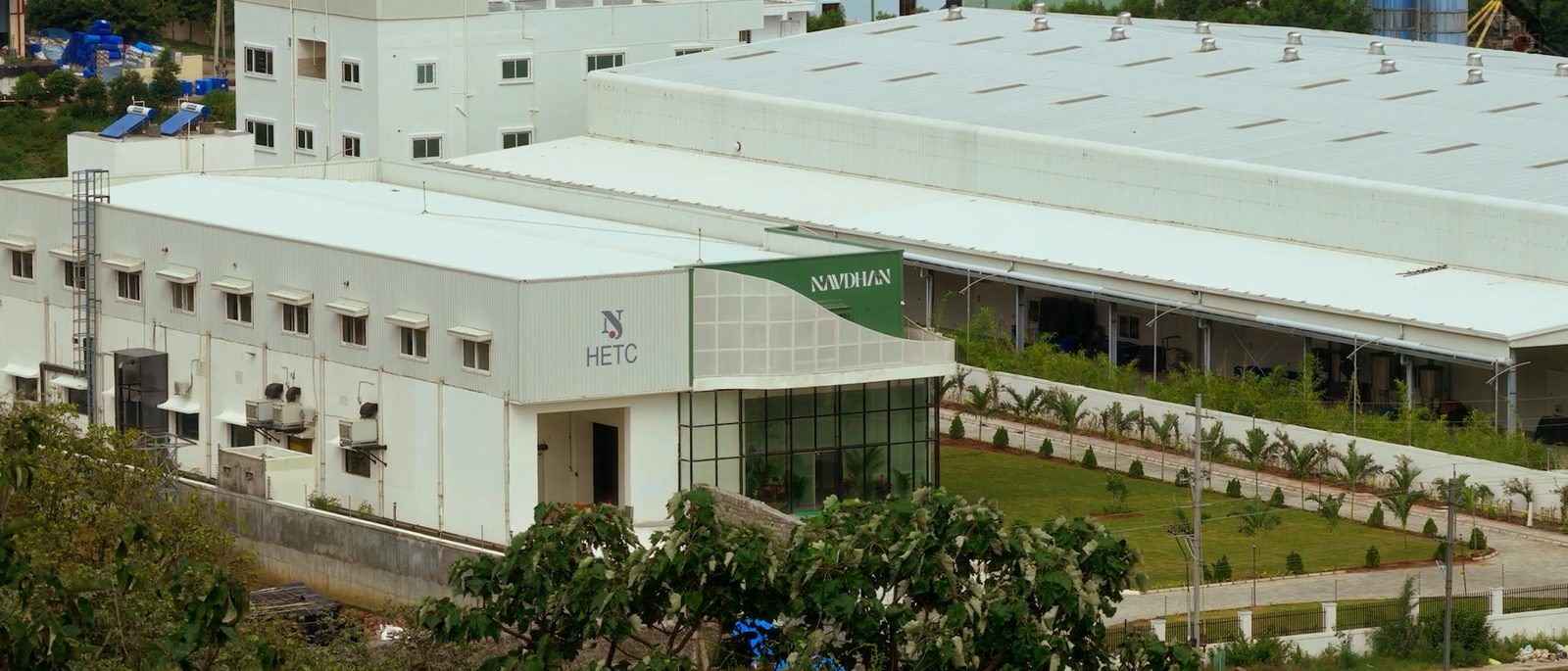
Facility or process, landscape
Naturally sprouted, dried at controlled temperatures.
We sprout and mill sorghum, finger millet and pearl millet flours through a scientifically controlled germination process that breaks down phytates and opens up the mineral content of the grain. Consistent, traceable, tested lot by lot, and produced at a scale that can supply a formulation trial or a recurring container programme.
Key facts about our product.
Certification.
We believe in strict documentation. Below are our current, verifiable certifications. For standards like kosher, halal and GFCO gluten-free, our facility already operates to compliance standards. We can immediately initiate formal certification for volume buyers who require it.
Third-party laboratory testing is separate from certification and is in place today: NCML and FARE Labs, both NABL accredited. Documentation →
We have never processed wheat.
Not on any line, not in any year. Since the facility was built it has handled millets and sorghum and nothing else – no wheat, no dairy, no nuts, no soy, no egg.
That is different from segregation. A supplier who segregates is managing a hazard that exists in their building. We do not have the hazard. We also source from Telangana, where the cropping pattern is rice, maize and pulses rather than wheat, so the exposure that produces the results above does not arise the same way in this supply chain.
Then we test every grain individually, from its own lot, and publish the number. Testing is the confirmation, not the only control.
Sprouted before milling, which nothing else on the US market is.
Every commercial millet and sorghum flour we can find in the United States is milled from raw grain. We soak and germinate the grain under controlled humidity, airflow and timing before it is dried and milled.
Millet and sorghum are mineral-dense grains. They are also high in phytic acid, which binds those minerals in the gut so that the figure on a nutrition panel and the amount a body absorbs are two different numbers. Germination activates the grain’s own phytase and degrades it.
Measured on paired raw and sprouted material across nine production lots:
Phytic acid, raw grain to sprouted flour
mg per 100 g · 9 lotsFilled marker is raw grain, hollow marker is the sprouted flour. Figures are the mean of paired lots from our own quality control. Independent confirmation by a US laboratory is in progress, and the reports are available on request. What this does and does not let you claim →
The ratio is the number, not the percentage.
A percentage drop in phytic acid does not prove much on its own. The real metric is the phytate to mineral ratio, and improving it through sprouting gives a formulator three things.
- Minerals less bound. Phytate to calcium and phytate to iron both cross below their commonly cited thresholds, the point at which inhibition is considered substantially relieved. Zinc improves roughly fivefold and falls just short, so we do not claim it.
- Higher inclusion rates. Sprouting reduces the bitter aftertaste of raw millet, which is what normally caps how much of it a blend can carry.
- Better baking. Water absorption shifts, which shows up in crumb structure and in how long a product takes to stale.
One balanced blend, already formulated.
Formulating three unfamiliar grains is usually trial and error. We did that work: 35.7 % finger millet, 35.7 % sorghum and 28.6 % pearl millet. We use slightly less pearl millet because it has the highest fat content and the strongest flavour. This specific 35.7 / 35.7 / 28.6 ratio balances the taste profile, protects the 12-month shelf life, and maximises the iron content.
Dietary fibre is 12.57 g per 100 g, measured by AOAC 985.29, the method a US nutrition panel requires. At a 30 g serving that supports a Good Source of Fibre claim on your retail pack. We will publish the full panel and any further claims it supports once US laboratory results are in.
Need a custom ratio? Because we hold full analyses on each grain, we can compute a valid specification and verify the claims for any custom blend without re-testing.
Sprouted finger millet
Ragi. Among the most calcium-dense cereal grains, and the one with no direct US-grown equivalent.
SpecificationSprouted sorghum
Jowar. 8.94 g dietary fibre per 100 g, neutral flavour, the most familiar to US formulators.
SpecificationSprouted pearl millet
Bajra. Iron-rich, with a fuller flavour that sprouting noticeably rounds off.
SpecificationWhere these flours are being used.
Sorghum and millet flour are both rated low FODMAP by Monash University, which matters for the large share of the gluten-free market that is coeliac with persistent symptoms, or IBS. We supply bakeries, brand owners, manufacturers and distributors.
If your application is not listed, ask anyway. Sprouted millet behaves differently enough from raw that the useful answer usually comes from a trial rather than a specification sheet.
Gluten-free bakery
Breads, crackers, cookies and blends. Gluten not detected at LOQ 2 mg/kg, on each grain individually. Sprouting lowers bitterness, which is what caps millet inclusion.
The gluten data →Infant and toddler
Cereals, porridges and first foods. Single-category facility. Heavy metals below LOQ, with speciated inorganic arsenic being commissioned against FDA Closer to Zero.
Contaminant panel →Breakfast and mixes
Pancake, waffle and dosa mixes. Water absorption shifts on sprouting, so hydration needs adjusting from a raw-flour baseline. We will supply matched material for the trial.
What sprouting changes →Snacks and pasta
Extruded snacks, puffs, premium pasta. Two tonnes a day supports a development run through to recurring supply. Particle size 100 % through 1 mm.
Specifications →Nutrition and beverage
Nutritional bases and blends. Finger millet is among the most calcium-dense cereal grains. Sorghum and millet flour are both Monash-rated low FODMAP.
The research →Something else
If your application is not here, it is still worth asking. Several of the tests we now hold exist because a buyer asked a question we could not answer.
Talk to a food technologist →Manufactured in India. Sold and supported in the United States.
HETC USA, Inc. is a Delaware corporation registered in New York, and it is your counterparty. You raise a purchase order to a US company, you are invoiced by a US company, and a US company carries the Foreign Supplier Verification Program obligations that come with importing.
That matters because FSVP responsibility falls on the US importer. If you buy direct from an overseas mill, it falls on you. Here it does not.
Manufacturing is at the HETC Foods Pvt. Ltd. facility in Telangana, an affiliated company under common ownership. Not a broker relationship, and not a third-party mill we found on a sourcing platform. HETC stands for Healthy, Easy To Cook. The company was founded by Sai Srinivas Vavilala and Srinivas Garimella, who spent twenty-five years building Vega Conveyors & Automation into an industrial automation business before exiting through a stake sale to Daifuku of Japan. The plant was built with that manufacturing discipline behind it, which is why the process controls look the way they do.
That range spans a bakery ordering a few bags through to a manufacturer taking recurring container loads. Pack formats are not fixed: we produce against contracts, so the pack follows the order rather than the other way round. Available as conventional supply, and as USDA Organic certified once NOP certification completes. Quality and documentation →
Tell us what you are formulating.
We will send samples, the full test report package, and a straight answer on whether we can supply what you need at the volume you need it.