
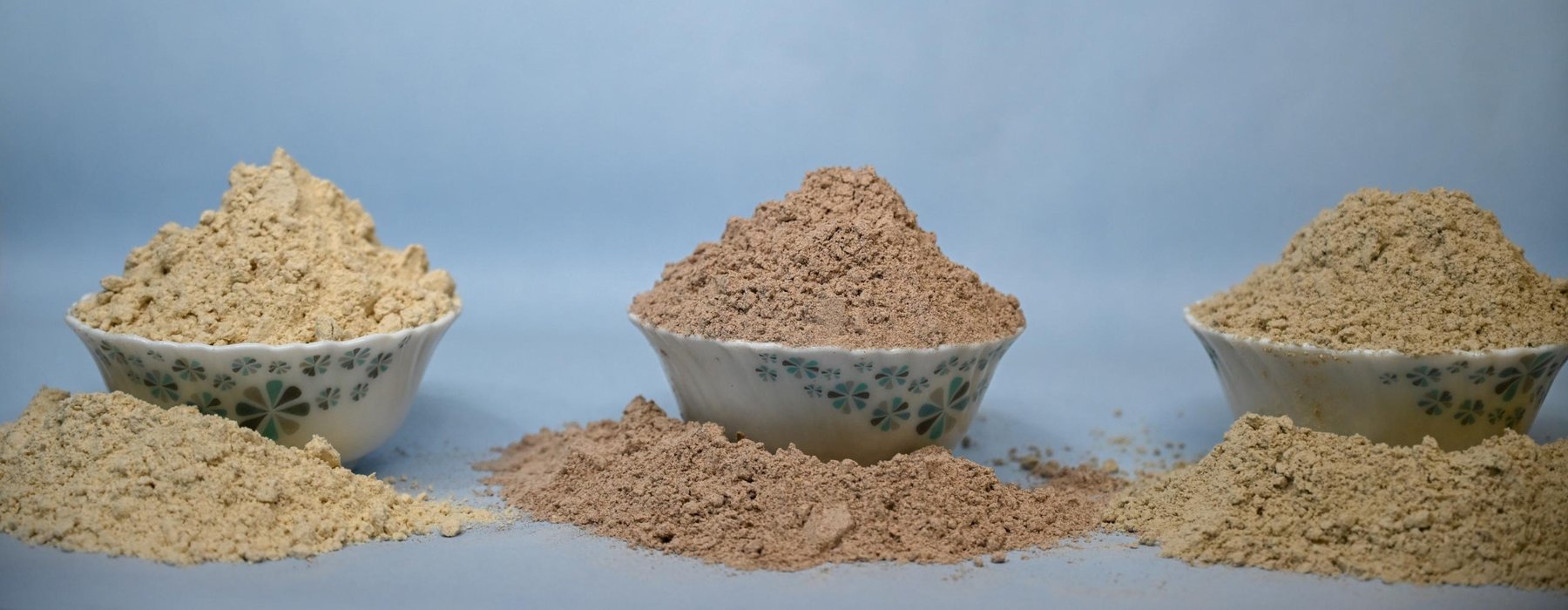
Three sprouted flours, one balanced blend, and capability for any blend.
We offer our three sprouted flours individually, alongside our flagship Triple Blend. We can also produce any blend of these three ancient grains. Nutrition and technical data are presented separately for each, verified by accredited laboratories.
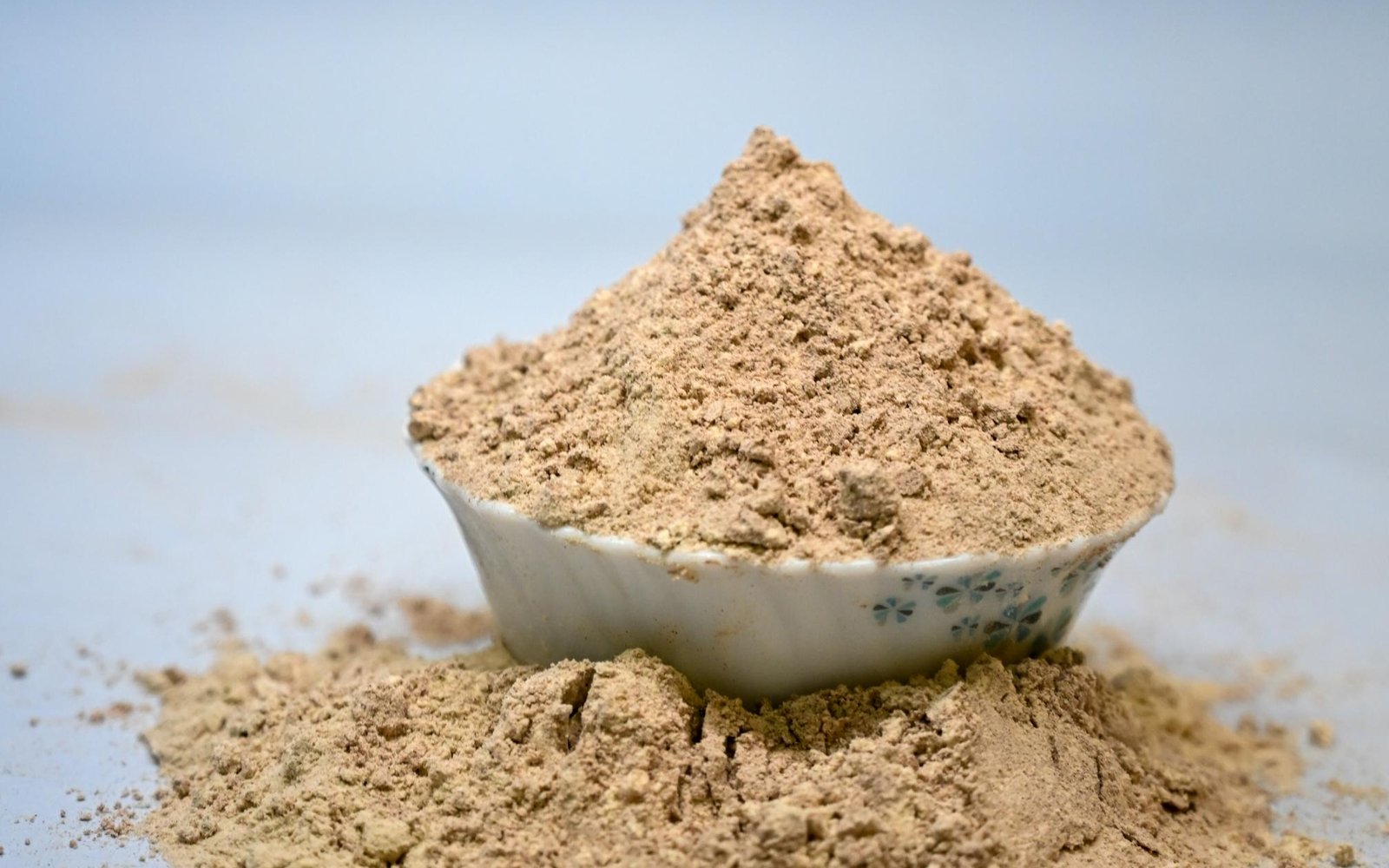
Balanced Triple Millet Blend
Most buyers evaluating three unfamiliar grains have to work out the ratio themselves, and the first attempt is usually wrong. Too much pearl millet and the flavour dominates; too little finger millet and the calcium advantage disappears.
We did that work. The ratio below came out of our own formulation testing and it is the one we lead with.
| Sprouted finger millet (ragi) | 35.7 % · 25 g per 70 g serving |
|---|---|
| Sprouted sorghum (jowar) | 35.7 % · 25 g per 70 g serving |
| Sprouted pearl millet (bajra) | 28.6 % · 20 g per 70 g serving |
Why each grain sits where it does
Finger millet: the mineral powerhouse. It drives the calcium content while naturally improving water absorption for a better crumb structure in baking.
Sorghum: the neutral base. It provides a mild, familiar flavour profile that lets this blend slot cleanly into an existing recipe without altering the taste.
Pearl millet: the iron driver. It is the most strongly flavoured and highest-fat grain of the three, so we cap it at just under 30 per cent to maximise its iron contribution while protecting the blend’s flavour and stability.
Per 100 g of the Balanced Triple Blend. Two laboratories, two samples; the full panels and the mineral spread are below.
| Energy | 349.78 kcal |
|---|---|
| Protein | 11.17 g |
| Total carbohydrate | 76.35 g |
| Dietary fibre (AOAC 985.29) | 12.57 g |
| insoluble | 11.94 g |
| soluble | 0.63 g |
| Total fat | 2.76 g |
| Moisture | 8.80 % |
| Total ash | 0.92 % |
| Calcium | 92.10 mg |
| Iron | 1.47 mg |
| Magnesium | 100.36 mg |
| Zinc | 0.85 mg |
| Vitamin B6 | 1.80 mg |
|---|---|
| Biotin, vitamin B7 | 34.24 µg |
| Niacin, vitamin B3 | 2.70 mg |
| Folate, vitamin B9 | 38.50 µg |
| Thiamin B1, riboflavin B2, B5 | Below LOQ 0.5 mg |
| Vitamin B12 | Below LOQ 0.05 µg |
| Vitamin C | Below LOQ 1.0 mg |
| Myo-inositol | 0.46 % |
| Total amino acids | 8.5 % |
| Gallic acid | 0.96 % |
| Total flavonoids | 0.40 % |
| Tannin | 0.42 % |
Two accredited laboratories, two separate samples. Their mineral results differ: Vimta reads calcium 158.86 mg, iron 2.18 mg, magnesium 131.13 mg and zinc 1.22 mg per 100 g against NCML’s figures above. We publish the lower set and are running a third sample to settle the spread. Full reports from either laboratory on request.
| Water absorption (IS 12516) | 72.66 % |
|---|---|
| Water activity | 0.687 aw |
| Particle size | 100 % through 1 mm sieve |
| Bulk density | 0.44 g/ml |
| Gluten | Not detected |
| Glyphosate | Below LOQ 0.01 mg/kg |
| Fumonisin B1 + B2 | Below LOQ 1.0 µg/kg |
| Ochratoxin A | Below LOQ |
| Lead | 0.03 mg/kg |
| Arsenic, cadmium, mercury | Below LOQ 0.01 mg/kg |
| E. coli, Salmonella | Absent |
| Phytic acid | 234.73 mg/100 g |
| Vitamin B6 | Excellent source at 30 g and at 40 g |
|---|---|
| Biotin, vitamin B7 | Excellent source at 30 g and at 40 g |
| Dietary fibre | Good source at 30 g and at 40 g |
30 g is the reference amount for flour. 40 g is the reference amount for a hot cereal. Claims are calculated from the measured blend figures above, not from the single grains. Because we also hold full analyses on each grain individually we can compute a specification for a custom blend.
Technical data sheet request a copy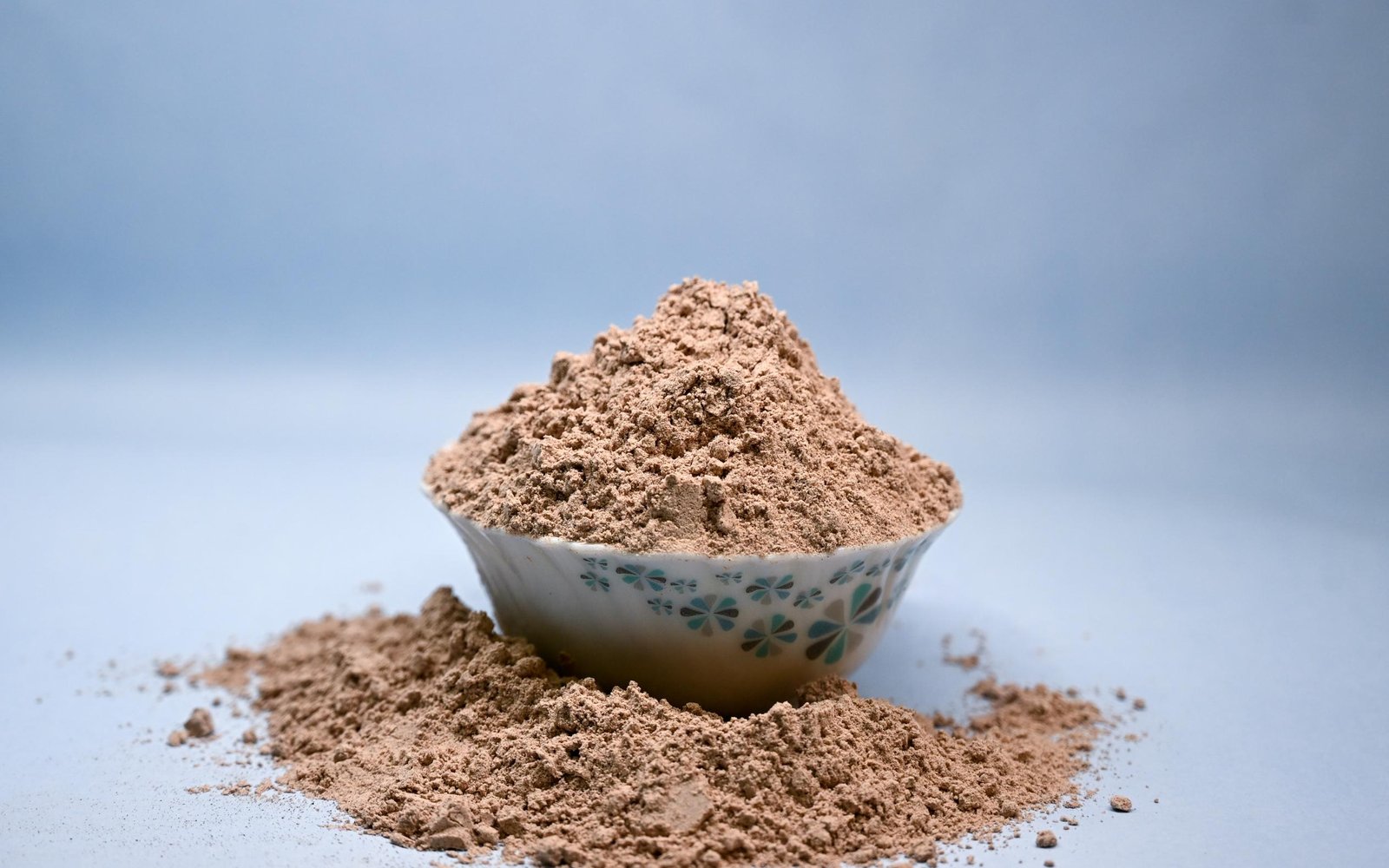
Sprouted finger millet flour
Finger millet (Eleusine coracana) has no true US-grown equivalent. It is among the most calcium-dense cereal grains, at roughly 330 to 365 mg per 100 g. In raw flour that calcium is locked behind phytic acid; sprouting takes phytic acid from 1,050–1,200 down to 250–274 mg/100g and the phytate-to-calcium molar ratio from 0.11 to 0.02.
Profile: reddish-brown, fine milling, with a mild malted character.
Stability: the most moisture-stable of the three. Across a twelve-month accelerated shelf-life study, moisture variance was effectively nil.
Per 100 g of flour. The full panel is below.
| Energy | 393.55 kcal |
|---|---|
| Protein | 11.37 g |
| Total carbohydrate | 80.02 g |
| Dietary fibre | 9.00 g |
| Total sugars | 3.00 g |
| Total fat | 3.11 g |
| of which saturated | 0.84 g |
| monounsaturated | 1.50 g |
| polyunsaturated | 0.77 g |
| trans fat | Not detected · DL 0.05 g |
| Cholesterol | Below LOQ 0.3 mg |
| Calcium | 330 to 365 mg |
| Iron | 3.09 mg |
| Sodium | 19.53 mg |
| Potassium | 412 mg |
| Vitamin D | 0 µg |
| Moisture | 7.73 % |
|---|---|
| Water activity | 0.676 aw |
| Acid insoluble ash (dry basis) | 0.027 % |
| Zinc | 15.32 mg/kg |
| Particle size | 100 % through 1 mm (18 mesh) |
| Gluten | Not detected · LOQ 2 mg/kg |
| Phytic acid, sprouted | 250–274 mg/100 g |
| Phytic acid, raw grain | 1,050–1,200 mg/100 g |
| Shelf life | 12 months |
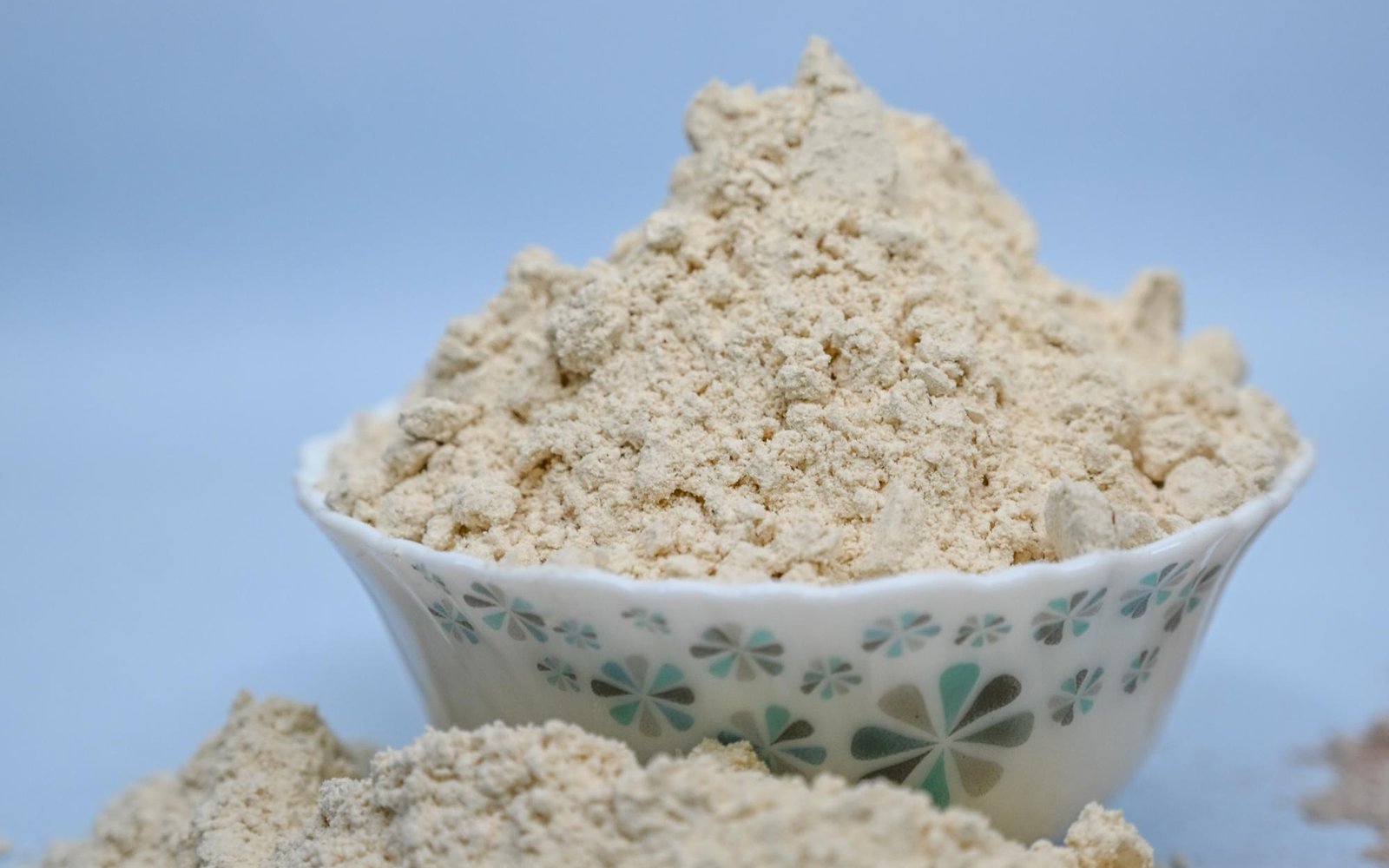
Sprouted sorghum flour
Sorghum (Sorghum bicolor) is the most familiar grain to US formulators. Pale, neutral in flavour, and the lowest in saturated fat of our range at 0.53 g per 100 g.
In bulk commodity markets sorghum is notorious for gluten cross-contamination through shared milling equipment. Because we process it in a dedicated facility, our results come back not detected.
Per 100 g of flour. The full panel is below.
| Energy | 377.40 kcal |
|---|---|
| Protein | 10.22 g |
| Total carbohydrate | 77.11 g |
| Dietary fibre | 8.94 g |
| Total sugars | 2.87 g |
| Total fat | 3.12 g |
| of which saturated | 0.53 g |
| monounsaturated | 1.17 g |
| polyunsaturated | 1.43 g |
| trans fat | Not detected · DL 0.05 g |
| Cholesterol | Below LOQ 0.3 mg |
| Calcium | 53.95 mg |
| Iron | 2.56 mg |
| Sodium | 32.28 mg |
| Potassium | 109 mg |
| Vitamin D | 0 µg |
| Moisture | 7.33 % |
|---|---|
| Water activity | 0.672 aw |
| Acid insoluble ash (dry basis) | 0.025 % |
| Alcoholic acidity (dry basis) | 0.079 % |
| Zinc | 11.52 mg/kg |
| Particle size | 100 % through 1 mm (18 mesh) |
| Gluten | Not detected · LOQ 2 mg/kg |
| Phytic acid, sprouted | 230–250 mg/100 g |
| Phytic acid, raw grain | 550–650 mg/100 g |
| Shelf life | 12 months |
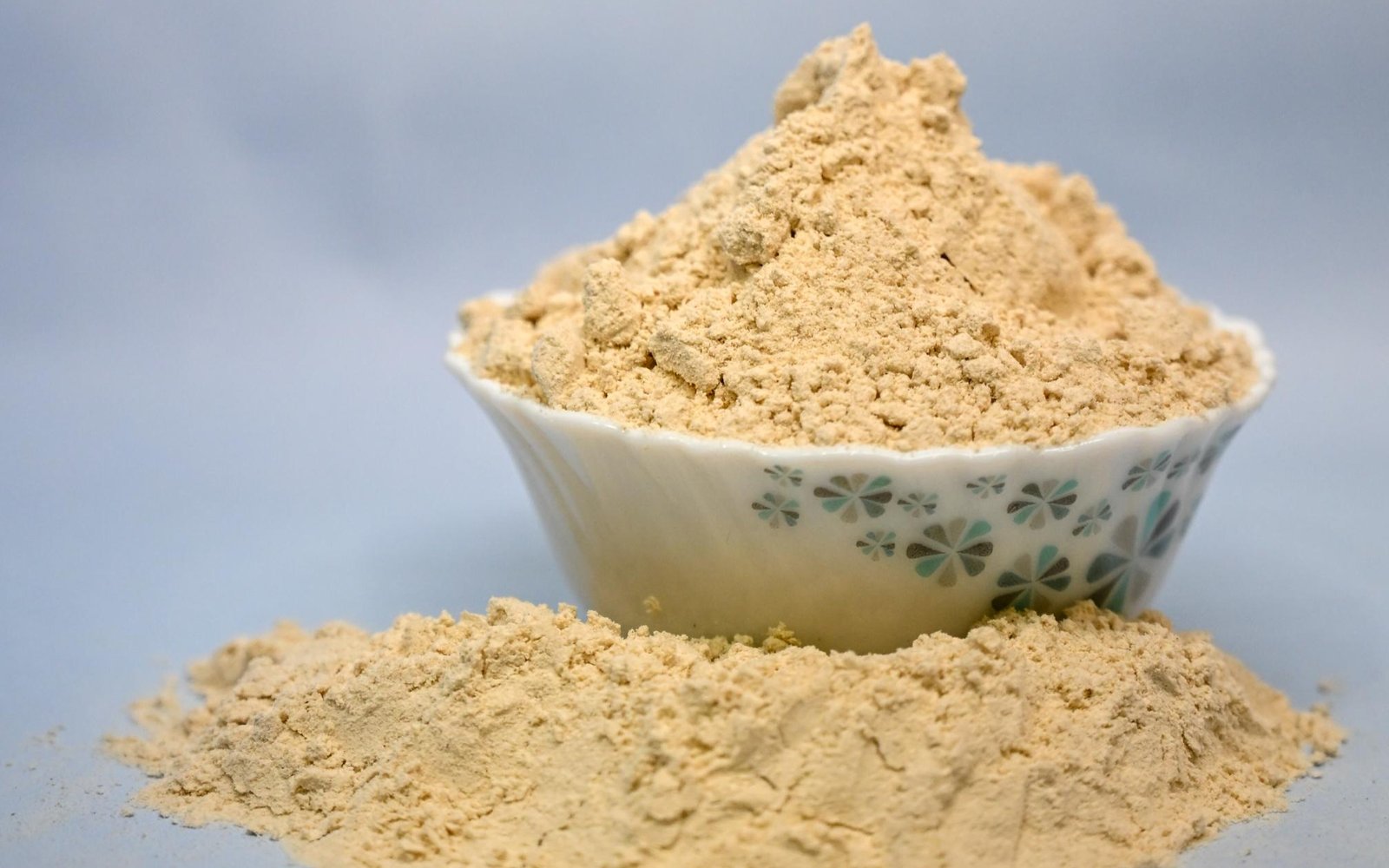
Sprouted pearl millet flour
Pearl millet (Pennisetum glaucum) is highly nutrient-dense but historically difficult to formulate with because of its natural bitterness. It also has the highest fat content of the three at 5.86 g per 100 g, against 3.11 for finger millet and 3.12 for sorghum.
Sprouting significantly neutralises the bitter profile. To demonstrate lipid stability we track alcoholic acidity, the marker for lipid degradation. Over a twelve-month accelerated study it moved from 0.13 to 0.14 g/100g.
Per 100 g of flour. The full panel is below.
| Energy | 398.46 kcal |
|---|---|
| Protein | 10.19 g |
| Total carbohydrate | 76.24 g |
| Dietary fibre | 9.11 g |
| Total sugars | 2.44 g |
| Total fat | 5.86 g |
| of which saturated | 2.27 g |
| monounsaturated | 1.46 g |
| polyunsaturated | 2.03 g |
| trans fat | Not detected · DL 0.05 g |
| Cholesterol | Below LOQ 0.3 mg |
| Calcium | 35.29 mg |
| Iron | 3.93 mg |
| Sodium | 8.37 mg |
| Protein (N×6.25, dry basis) | 11.12 % |
|---|---|
| Total fat (dry basis) | 5.49 % |
| Crude fibre (dry basis) | 1.54 % |
| Moisture | 8.03 % |
| Water activity | 0.688 aw |
| Acid insoluble ash (dry basis) | 0.028 % |
| Alcoholic acidity (dry basis) | 0.070 % |
| Zinc | 15.82 mg/kg |
| Particle size | 100 % through 1 mm (18 mesh) |
| Gluten | Not detected · LOQ 2 mg/kg |
| Phytic acid, sprouted | 250–350 mg/100 g |
| Phytic acid, raw grain | 750–850 mg/100 g |
| Shelf life | 12 months |
The nutrition panel above is as received; this table is on a dry basis. At 8.03 % moisture, NCML’s 5.49 % fat on a dry basis is 5.05 g per 100 g as received, against the 5.86 g in the panel above, which a second accredited laboratory measured on a separate sample. Protein cross-checks between the two laboratories to within 0.4 %.
Technical data sheet request a copyCapacity and minimum orders
Our facility produces two tonnes of finished sprouted flour per day, roughly 50 tonnes a month and 600 a year, close to three twenty-foot containers a month. Large enough to hold a manufacturer’s continuity of supply, small enough that a bakery ordering a pallet still gets attention.
We produce against contracts rather than holding speculative inventory, so lead time runs from order confirmation rather than from stock. For a first shipment allow 8 to 10 weeks: production, then consolidation, then ocean freight from India to the US East Coast, then customs clearance. That shortens once we are shipping to you regularly.
Three ways to work with us
Ingredient supply. You buy the flour, single or blended, and formulate with it. This is most of what we do and the rest of this site describes it.
Blend to your specification. You tell us the ratio, or the functional target, and we produce and document it as a fixed specification with its own certificate of analysis. Useful when a blend is part of your formulation rather than something you want to mix on your line.
Contract manufacturing. HETC Foods Pvt. Ltd. runs extensive white-label manufacturing in India. If you want a finished retail product made rather than an ingredient supplied, we can facilitate that directly.
| Evaluation samples | 500 g pouches · already available in NY |
|---|---|
| Standard pack | 25 kg multi-wall bags |
| Typical minimum order | 1 tonne · 40 bags, about one pallet |
| Bakeries and small producers | Below one tonne by discussion |
| Manufacturers and brand owners | Pallet through full container |
| Distributors | Container quantities · terms by discussion |
| Full container (20 ft) | Approx. 18 tonnes |
| Annual capacity | Approx. 600 tonnes |
One tonne is where most first orders land, not a floor we enforce. Bakeries and bench trials routinely take less, and we would rather start small with the right customer than turn one away on volume. Pack format is not fixed either: because we produce against contracts rather than to stock, the pack follows the order. If your line takes 25 kg bags, or 50 lb, or totes, tell us and we will quote it.
If you are a bakery wondering whether you are too small to bother us: you are not. Early customers who tell us how the flour behaves in a real production environment are worth more to us right now than volume is.