
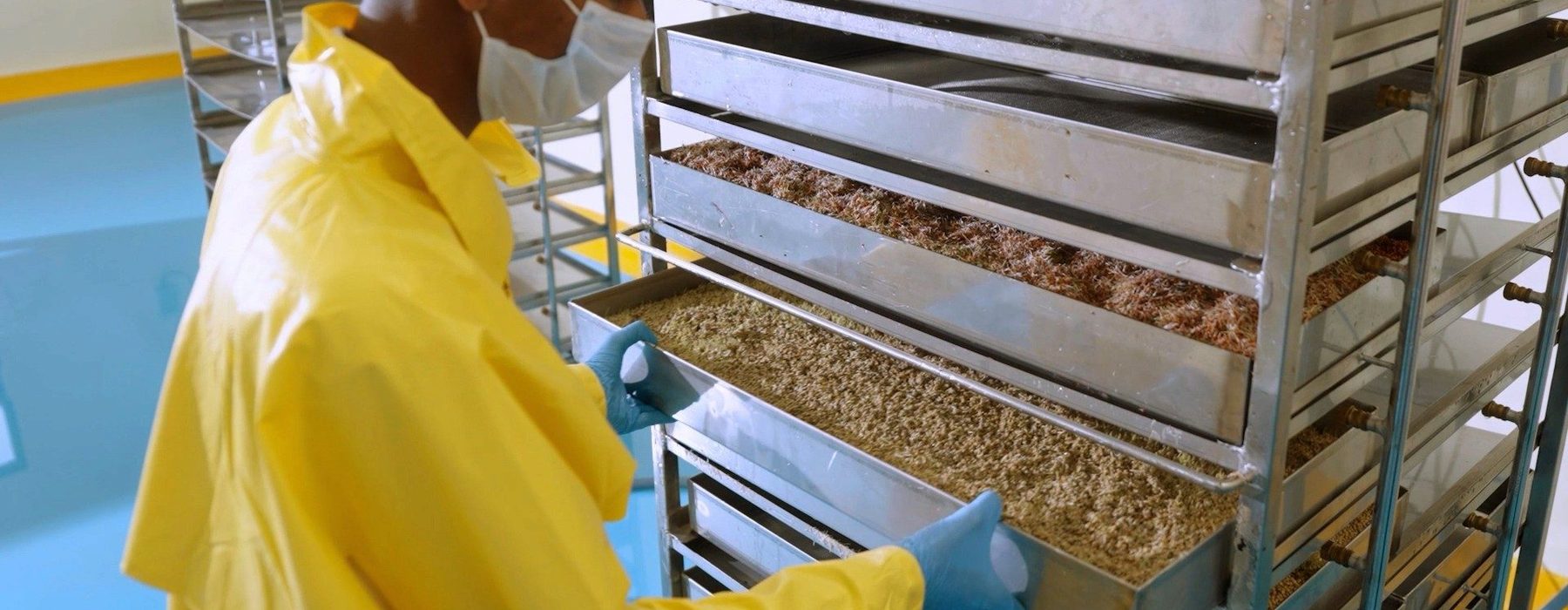
What sprouting changes.
Commercial millet and sorghum flour is generally milled from raw grain, and raw grain is high in anti-nutrients such as phytate and tannins. We germinate ours first, through a sprouting process optimised to drive down the phytate to mineral molar ratios and maximise mineral bioaccessibility.
Five controlled stages
Soaking grain is a standard household practice. Doing it identically across commercial volumes requires strict environmental controls.
Clean, grade and wash
Incoming grain is cleaned and stored under natural CO2 rather than chemical fumigation.
Soak
Time and water temperature are strictly controlled to hit a target moisture level. Under-soaking causes uneven sprouting; over-soaking triggers fermentation.
Germinate
Grain is held at 28 to 32 degrees and 50 to 90 per cent relative humidity for 48 to 72 hours. Release is on a minimum post-germination hold of 48 to 60 hours, not on visible sprouts. Phytate degradation continues after sprouting is visible, and we set the hold time by testing rather than by eye.
Rinse
Germinated grain is rinsed in centrifuges before it goes to the dryer. This removes the steep water and the surface load that builds up over 48 to 72 hours of warm, humid holding, so what enters the dryer is cleaner than what came off the trays.
Dry and mill
We arrest germination in a fluidised bed dryer, then mill to a fine flour. Product temperature stays at 40 to 45 degrees. This is a drying and stabilisation step that preserves what germination produced. Roasting is faster, but the heat denatures the enzyme systems and alters the nutritional profile germination just created. From cleaning onward the product is not handled by hand.
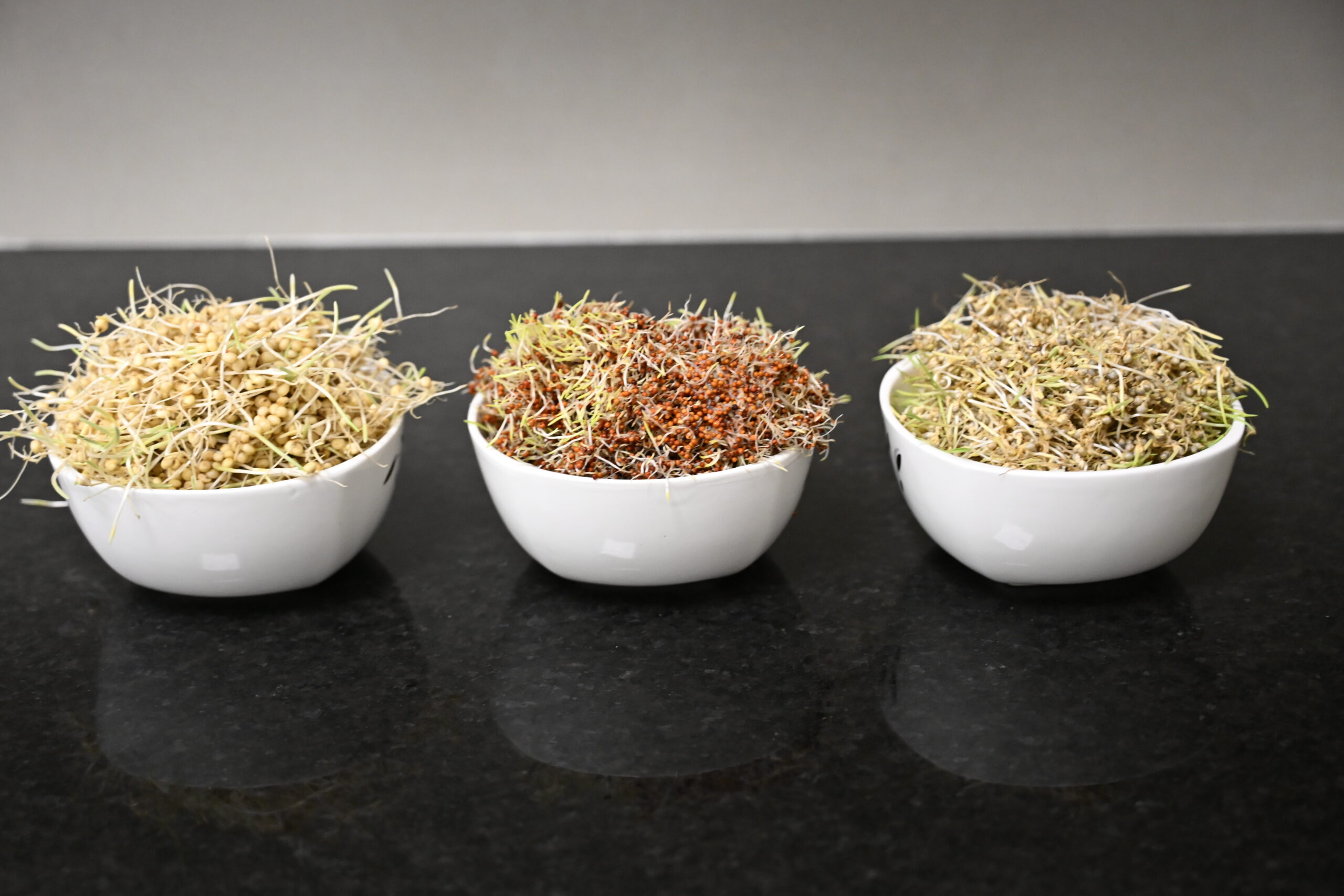
Functional changes for a formulator
Bitterness falls
Raw pearl and finger millets carry a bitter, chalky aftertaste caused by polyphenols in the bran. This bitterness is usually the ceiling for formulators: you run into a flavour limit long before you run into a functional one. Sorghum is the mildest of the three and is the reason the blend has a neutral base at all.
Water absorption shifts
Sprouting partially breaks down the starch and protein structure. In our trials, sprouted finger millet holds noticeably more water, producing a softer, moister crumb. Because sprouted flour absorbs more water, you cannot usually substitute it one for one against raw commodity flour. You will likely need to adjust hydration levels in your formulation during initial bench trials.
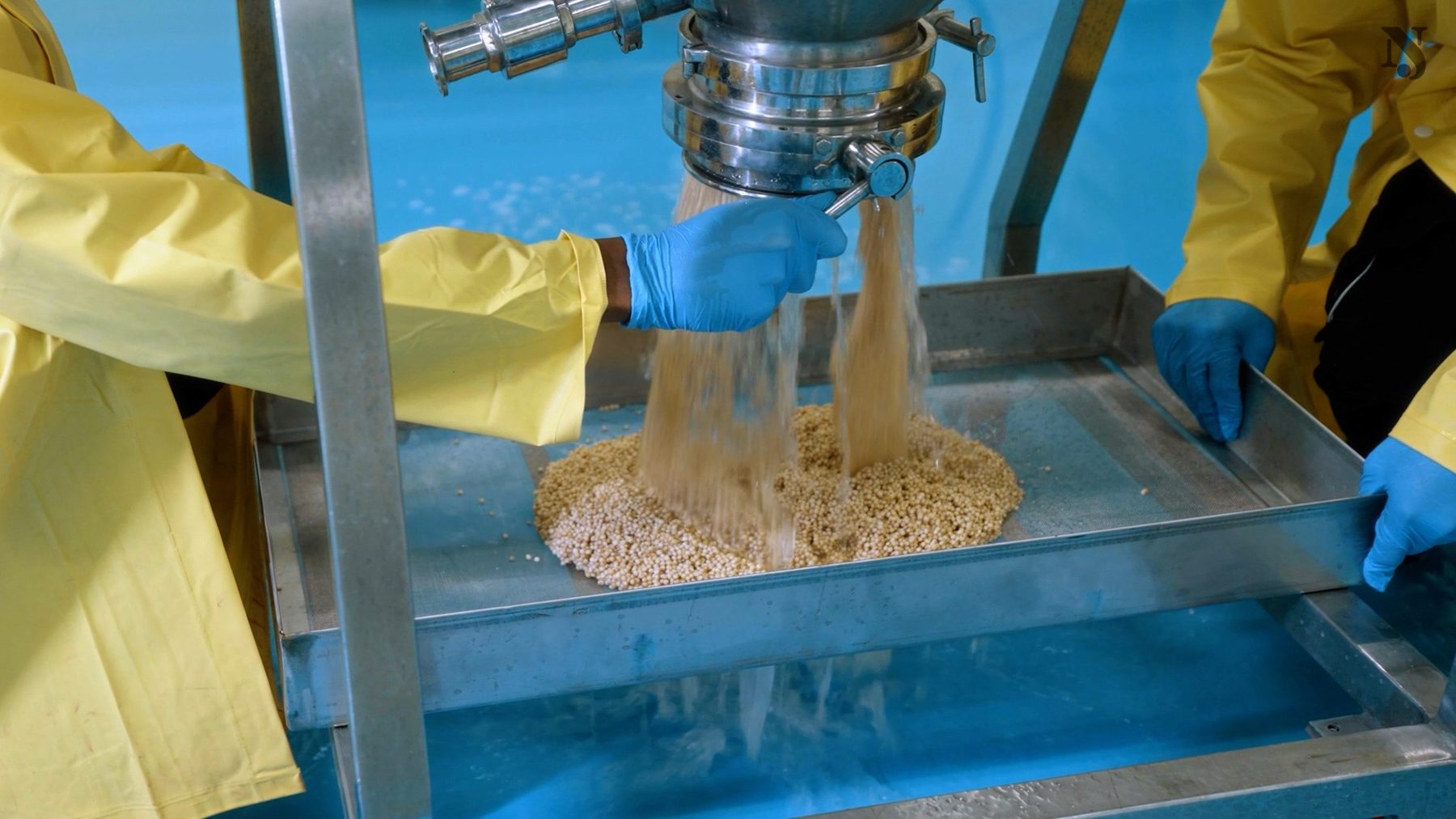
What germination does to phytate
Germination activates the grain’s own phytase. The enzyme strips phosphate groups off phytic acid one at a time, through a series of intermediate inositol phosphates, and the end point of that sequence is free inositol. As a result an anti-nutrient goes down and a nutrient goes up.
01 Phytic acid is reduced
Millet is genuinely mineral-dense. Raw millet is also high in phytic acid, which binds calcium, iron and zinc in the gut. So the mineral content printed on a nutrition panel and the mineral a consumer can actually take up are two different figures, and the size of that gap is set largely by phytate. Phytic acid in our flour runs 60 to 77 per cent below the raw grain it was milled from.
What the literature establishes. Germination of pearl millet significantly increased the HCl-extractability of calcium, iron, zinc, copper and manganese, with a corresponding fall in phytate phosphorus. Khetarpaul and Chauhan, International Journal of Food Science and Technology 24, 327 to 331, 1989. View the study → A finger millet malting optimisation study measured phytic acid down 45 per cent and tannin down 46 per cent, with in-vitro protein digestibility rising from 74 to 91 per cent and correlating with both. Najdi Hejazi and Orsat, Journal of Food Science and Technology 53, 1929 to 1938, 2016. View the study →
The molar ratio. This ratio dictates whether a mineral is actually freed up for the body to use.
| Phytate : calcium | 0.11 → 0.02 · threshold 0.17 |
|---|---|
| Phytate : iron | 33 → 7 · threshold 14 |
| Phytate : zinc | 78 → 16 · threshold 15 |
02 Free inositol is released
Inositol is where phytate degradation ends, and it is a nutrient in its own right. It is the backbone of the phosphatidylinositol second messengers that cells use to carry insulin and neurotransmitter signals, and a structural component of cell membranes.
Our Balanced Triple Blend measured 0.46 per cent free myo-inositol, which is 460 mg per 100 g. On a 40 g serving, the FDA reference amount for a hot cereal, that is 184 mg. On the 30 g flour reference amount it is 138 mg.
| Balanced Triple Blend | 460 mg |
|---|---|
| Cantaloupe | 355 mg |
| Orange | 307 mg |
| Grapefruit | 199 mg |
| Lime | 194 mg |
| Soybeans | 190 mg |
| Oats, dry | about 135 mg |
| Kidney beans | 130 mg |
| Lima beans | 110 mg |
| Green peas | 44 mg |
Comparison values from Clements and Darnell, American Journal of Clinical Nutrition 33, 1954 to 1967, 1980. Oats converted from the published 54.8 mg per half cup dry. Fruits are listed as eaten and are mostly water, so they read lower here than they would on a dry basis. The like-for-like comparison for a dry ingredient is the one against oats, where the blend runs roughly three times higher.
Why the amount matters. A review in Open Heart puts myo-inositol intake from a 2,000 kcal diet at roughly 720 mg a day, ranging from 250 to 1,650 mg depending on what is actually eaten. One 40 g serving of the blend therefore contributes close to a quarter of a typical day’s intake from a single ingredient. The same review notes that outside the brain, tissue myo-inositol content is highly dependent on dietary intake rather than on what the body synthesises for itself. DiNicolantonio and O’Keefe, Open Heart 9, e001989, 2022. View the review →
Free, not bound. In ordinary cereal flour most of the inositol is still locked up in phytate, and how much of it a person liberates depends on their own gut microbiota doing the work after the meal. Our sprouting performs that conversion in the grain, in the plant, before the flour is ever packed. What the laboratory measured is inositol that is already free.
What are the claims that we can make with our flour?
| “Made with sprouted millet” | Supported · process claim, production records |
|---|---|
| “Gluten-free” | Supported · not detected at LOQ 2 ppm, third-party |
| “Good source of calcium” | Supported for finger millet at a 40 g serving · not for the blend |
| “Reduced phytic acid” | Supported · paired raw vs sprouted across lots |
| “Improved mineral bioaccessibility” | Supported · calculated molar ratios for calcium and iron |
| “Easier to digest” / “IBS friendly” | Supported · Monash low FODMAP rating, plus enzymatic starch and protein breakdown |
Two different kinds of evidence support our flour
Measured, third-party, lot-traceable
These are hard numbers backed by lot-traceable third-party laboratory reports on our specific flour. That includes the under 2 ppm gluten tests, the 60 to 77 per cent phytic acid reductions, the calcium and iron molar ratios, the calcium content of finger millet, twelve month shelf life by accelerated study, and water activity of 0.672 to 0.688.
The mechanism, established in the literature
Germination is a heavily studied biological process. The findings below are based on germinated millets generally rather than on our specific facility’s flour. We label them that way deliberately, but they describe the same process we run and they are what a nutrition reviewer will look for.
- Protein digestibility. A finger millet malting optimisation study germinated grain for 24, 36 and 48 hours at 22, 26 and 30 °C and reported in-vitro protein digestibility rising from 74 % in the native grain to 91 % at the optimised condition, 48 hours at 30 °C. The same work recorded phytic acid down 45 % and tannin down 46 %, and found protein digestibility correlated with both. Najdi Hejazi and Orsat, Journal of Food Science and Technology 53, 1929 to 1938, 2016. View the study →
- Anti-nutrients and protein solubility. Sprouting minor millets produced significant decreases in phytic acid and condensed tannin, with enhanced protein solubility resulting in improved in-vitro protein digestibility. International Journal of Biological Macromolecules. View the study →
- Across varieties. Four millet varieties germinated for 24 to 72 hours showed increased protein digestibility, correlating with protease activity. Nguyen and colleagues, Journal of Food Processing and Preservation, 2022. View the study →
- Mineral extractability. Germination of pearl millet significantly increased HCl-extractability of calcium, iron, zinc, copper and manganese, with a corresponding fall in phytate phosphorus. Khetarpaul and Chauhan, International Journal of Food Science and Technology 24, 327 to 331, 1989. View the study →
The full research page, with citations and what each paper establishes →